Bob & Otto · Book 4 · How it works
Goodnight, Otto: the psychology behind the book
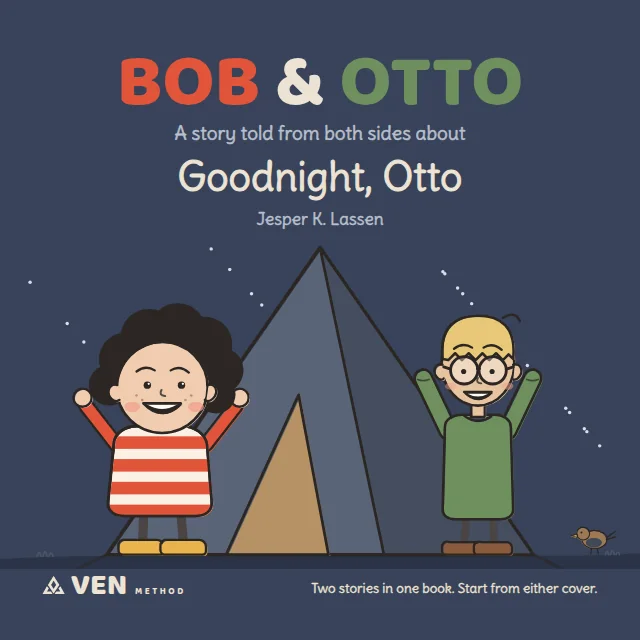
Two boys in a tent, a seam down the middle, and a silence. Bob thinks it means Otto is upset with him. Otto went quiet because he was happy. Goodnight, Otto is the quietest book in the series, and it is about a cue that gives a child almost nothing to go on: silence.

At a glance
- Ages
- 4 to 8 · read-aloud from about four, early readers alone
- What it practices
- Knowing that silence can mean many things, and checking instead of guessing
- The misreading
- A friend’s silence, taken as anger
- Opens and closes on
Are you nearly asleep?
- Length
- About 105 words in all · 22 lines, one per page · 34-page paperback, 8.5 × 8.5 in
- SEL competencies (CASEL)
- Social awareness (reading others’ feelings) · Self-awareness (worry) · Relationship skills (apologizing, checking in)
- Editions
- Paperback $8.99 (ISBN 979-8-9979707-3-4) · Kindle $2.99 · Spanish: Buenas noches, Otto, paperback (ISBN 979-8-9979707-8-9) and Kindle · buy direct or find a store
The two sides
Read from the front, it is Bob’s story. Turn the book over and read the same pages from the back, and it is Otto’s. Neither boy is wrong about everything, and neither is right about everything.
Bob’s side
- What he believes
- Otto went quiet because he is upset with him. The silence is an answer, and the answer is no.
- What he gets right
- Otto did go quiet, and they did lie with their backs to each other.
- What he misses
- Otto goes quiet when he is happy. He was listening for Bob to fall asleep.
In his own words, from his page in the book: When my friend goes quiet, I think I did something wrong.
I’m learning to ask before I decide that.
Otto’s side
- What he believes
- The quiet is comfortable. They are together under one roof; nothing needs saying.
- What he gets right
- Nothing was wrong. He wanted to hear Bob sleep.
- What he misses
- To someone else, quiet can sound like no. He did not say so.
In his own words, from his page in the book: I go quiet when I’m happy.
I’m learning that quiet can sound like no to somebody else.
The psychology behind it
A raised voice or a laugh is a cue a child can at least hear. Silence gives them nothing to go on, so whatever they are already feeling fills the gap. A worried child may read silence as disapproval; Bob says it outright on his own page: When my friend goes quiet, I think I did something wrong.
In the language of social information processing, the cue is ambiguous and the interpretation does all the work1.
Otto’s page names the other half: I go quiet when I’m happy.
Reviewer Deb Preston picked out exactly this: Gosh, this is a common misunderstanding with adults, too!
2 The book gives a child an early version of a skill adults still work on: someone else’s silence is information about them, not a verdict on you.
The resolution is simple. Neither boy makes a speech or waits for the other to go first. In the exact middle of the book, both pages say the same thing at once: Sorry I didn’t ask.
Each boy is sorry for the same omission, so the repair is mutual. That symmetry shows a child something worth knowing: a misunderstanding can belong to both people, and both can mend it with the same small act.
It is also a bedtime book in its rhythm. Read from the front, after the apology, the story turns to small night sounds (The wind pushed the tent and let go.
An owl a long way off.
) and then to the last lines before the goodnight: Everything got slower.
Your breathing, and mine.
A child is being read to sleep by a story about two children falling asleep.
How the words do it
This book makes the most use of a technique that runs through the series: a line left deliberately unfinished, so that whatever comes next completes it. Because the book is read in both directions, an unfinished line has two possible endings, one forward and one backward. Goodnight, Otto has three of them, each ending in a dash.
All the way down the middle—
Forward, Otto’s page finishes it: One roof over the two of us.
Backward, the line that follows is Otto’s I stayed on my half.
The same seam down the tent is a roof over both of them one way, and a border between them the other.
The whole time—
Forward: I wanted to hear you sleep.
Backward: Sorry I didn’t ask.
Near enough to hear—
Forward: You not saying anything.
Backward: An owl a long way off.
None of these lines change a single letter. Their meaning depends only on which way the book is turned. The covers are the one place the words do change: the front says Goodnight, Otto, the back Goodnight, Bob. The book opens and closes on the question both boys ask each other in the dark: Are you nearly asleep?
All the way down the middle— → One roof over the two of us.
All the way down the middle— → I stayed on my half.
What the pictures do
This is the only book in the series set at night, and its palette is the deep blue of a tent after dark. The seam down the middle of the tent echoes the spine of the book itself: two halves, one roof. Bob is never drawn angry, only uncertain. The sparrow still finds its place on every one of Otto’s pages.
Questions to ask after reading
Open questions work best: there is no single right answer, and the point is for the child to explain what they think. Ask a few, not all.
After Bob’s side
- Why did Bob think Otto was upset?
- What does it feel like when a friend goes quiet and you don’t know why?
- What did Bob decide to do?
After turning it over
- Why did Otto go quiet?
- What was Otto listening for?
- What do both boys say in the middle of the book?
After both sides
- Can being quiet mean different things? When are you quiet?
- What could Bob ask when Otto goes quiet?
- Why do you think both boys say sorry?
In a classroom or counseling session
Works best read slowly, in a quiet voice, at the end of the day. Read Bob’s side, pause on the middle spread where both boys say Sorry I didn’t ask.
Then turn the book over. Ask the children when they go quiet, and what it means. Ten minutes.
Ordering for a class or a school? Class sets are quoted directly: see orders and bulk copies.
Questions people ask about Goodnight, Otto
What age is Goodnight, Otto for?
Ages 4 to 8. It is written as a calm bedtime read-aloud, about 100 words in all.
What is Goodnight, Otto about?
Two friends sleep in a tent. Bob reads Otto’s silence as anger; from Otto’s side, he went quiet because he was happy and wanted to hear Bob fall asleep.
Why does the back cover say Goodnight, Bob?
Each cover names the boy you are saying goodnight to. Start from the front for Bob’s night, from the back for Otto’s.
Is there a Spanish edition?
Yes: Buenas noches, Otto (Bob y Otto, libro 4), on Kindle. The Spanish paperback is coming.
Can I order class sets?
Yes. Email jesper@danishmentalist.com for a quote, or see bobandotto.com/orders/.
Sources
- Crick, N. R., & Dodge, K. A. (1994). A review and reformulation of social information-processing mechanisms in children’s social adjustment. Psychological Bulletin, 115(1), 74–101. https://scholars.duke.edu/individual/pub658165
- Preston, D. (2026, September 24). Children’s book review: The Bob & Otto series (+ author interview). debpreston.com. https://debpreston.com/bob-and-otto-review/
- CASEL. What is the CASEL framework? Collaborative for Academic, Social, and Emotional Learning. https://casel.org/fundamentals-of-sel/what-is-the-casel-framework/