Bob & Otto · Book 1 · How it works
Half a Sentence: the psychology behind the book
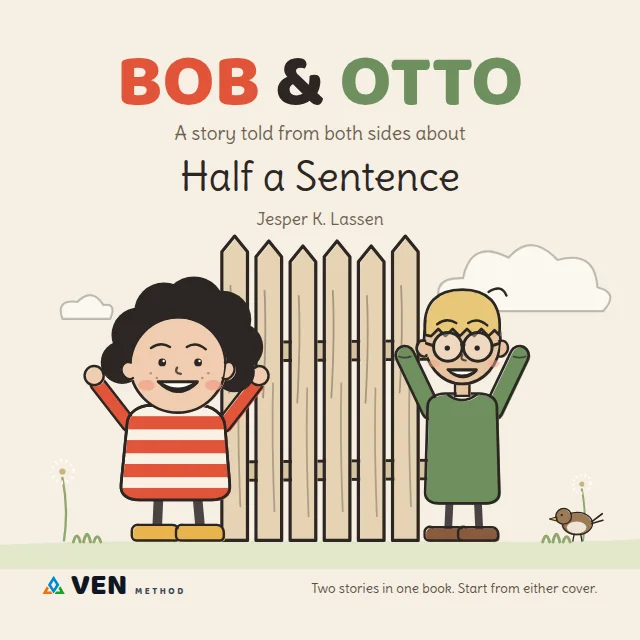
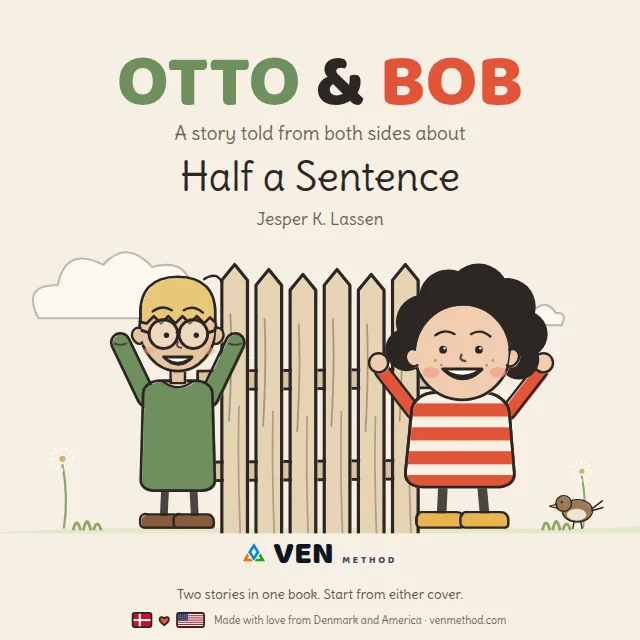
Bob hears five words through a fence and runs off with them. Otto was still talking. Half a Sentence is built around one of the most common ways children (and adults) get hurt by each other: reacting to a fragment as if it were the whole message.
Hear it read aloud
The whole book, read aloud, in 4 min 48 s. Press play and it plays right here. Read it Bob’s way first, then turn it over for Otto’s; the video goes front to back.
The narration in these videos is an AI-generated voice. The words and every picture are Jesper K. Lassen’s own work and are protected by copyright (© 2026 Jesper K. Lassen; published by VEN Method). They may be watched and shared freely; copying or reusing the illustrations or text requires written permission.
At a glance
- Ages
- 4 to 8 · read-aloud from about four, early readers alone
- What it practices
- Hearing the whole thing before deciding what it meant
- The misreading
- An overheard half-sentence, taken as the whole message
- Opens and closes on
You are my best friend.
- Length
- About 132 words in all · 22 lines, one per page · 34-page paperback, 8.5 × 8.5 in
- SEL competencies (CASEL)
- Social awareness (perspective-taking) · Relationship skills (communicating clearly) · Responsible decision-making (checking before reacting)
- Editions
- Paperback $8.99 (ISBN 979-8-9979707-0-3) · Kindle $2.99 · Spanish: Media frase, paperback (ISBN 979-8-9979707-5-8) and Kindle · buy direct or find a store
The two sides
Read from the front, it is Bob’s story. Turn the book over and read the same pages from the back, and it is Otto’s. Neither boy is wrong about everything, and neither is right about everything.
Bob’s side
- What he believes
- Otto said “Bob is not my friend.” He heard it with his own ears, so it must be true.
- What he gets right
- He did hear those exact words. He is not imagining them.
- What he misses
- The sentence was not finished. “Bob is not my friend — Bob is my best friend.”
In his own words, from his page in the book: I hear things fast. Sometimes faster than they were said.
I’m learning to hear the whole thing.
Otto’s side
- What he believes
- He was telling someone the most important thing about Bob, and saying it well.
- What he gets right
- He meant every word of it, and the words were kind.
- What he misses
- He put the important half last, and by the time he got to it, Bob was gone.
In his own words, from his page in the book: I say things slowly. Sometimes too slowly.
I’m learning to say the important half first.
The psychology behind it
Every social moment asks a child to do something before they can respond: read the cue, then decide what it means. Psychologists Nicki Crick and Kenneth Dodge described this as a sequence of steps, with interpretation sitting between noticing and reacting1. Children who habitually fill in ambiguous cues with a hostile meaning get into more conflict; a meta-analysis of 41 studies with over 6,000 participants found a robust link between hostile attribution of intent and aggressive behavior2. That research mostly concerns older and more aggressive children, but the mechanism is the same one every four-year-old meets on a playground: you hear part of something, and your mind finishes it for you.
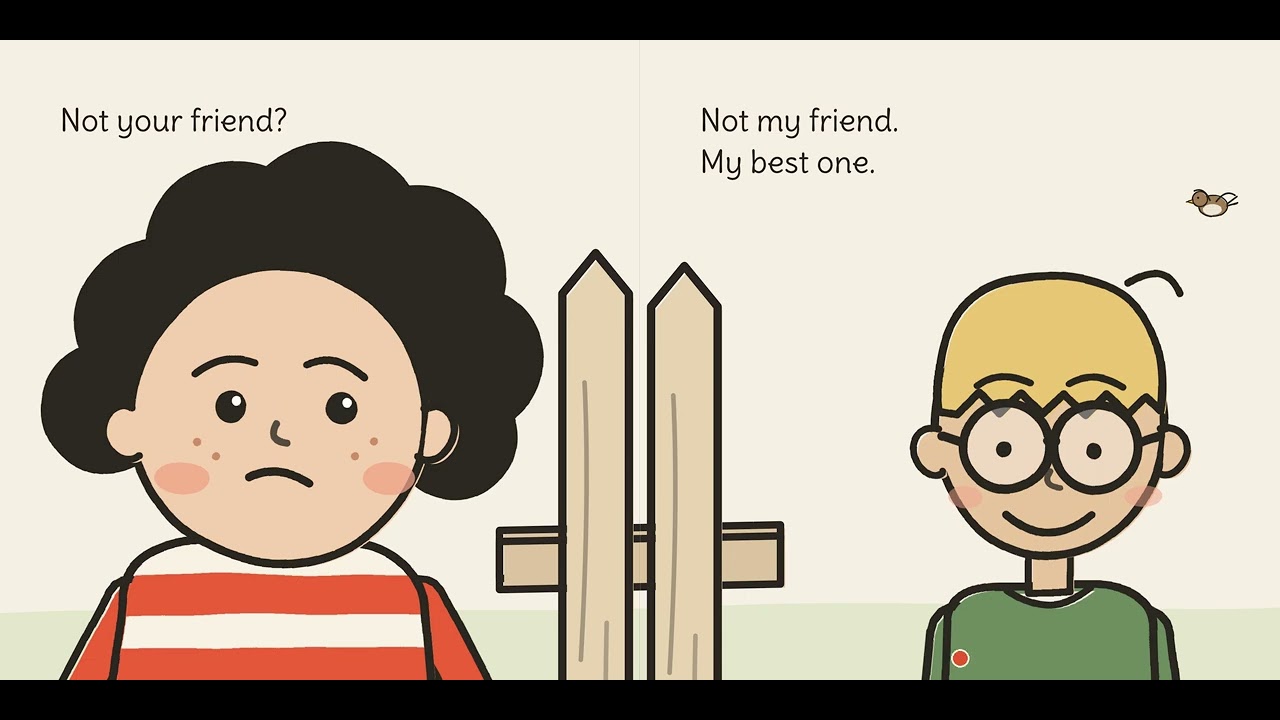
Half a Sentence puts that moment under a magnifying glass. On one spread the reader sees the two versions side by side: on Bob’s page, “Bob is not my friend.”
On Otto’s page, the whole thing: “Bob is not my friend — Bob is my BEST friend.”
A child does not have to be told that Bob misheard. They can see the missing half with their own eyes, on the page next to it.
That matters for how the lesson lands. In a study of 4-year-olds who heard about 70 picture books over four weeks, books that spelled out characters’ mental states increased the children’s mental-state vocabulary, but children who had to work out those states from the story did better on false-belief tasks3. It is one small study, so it is suggestive rather than conclusive, but it fits what this book does: it never says “Bob jumped to a conclusion.” The reader finds that out by turning the book over.
The age range is deliberate too. Around ages 3 to 5, children go from failing to passing classic false-belief tasks: they come to understand that someone can believe something that is not true4. Bob is a believable, sympathetic example of exactly that. He is not wrong about what he heard; he is wrong about what it meant. For a child who has just acquired the idea that beliefs can be false, that is the next step: my belief can be false too.
The book also gives both boys a job. Bob is learning to listen to the end. Otto is learning to say the important half first. Neither is the villain, and the misunderstanding is shared. That is closer to how real friendships break and mend, and it keeps a young reader from learning the wrong lesson (“the one who got hurt was right”) or its opposite (“the one who got hurt was silly”).
How the words do it
The book is one short text, printed once, that reads as Bob’s story from the front and as Otto’s story from the back. Each spread has one line for each boy. Forward, you read Bob’s page and then Otto’s. Turn the book over and read back to front, and Otto’s page comes first. The words do not change. Their order does, and with it, what they mean.
Take spread six. Forward, Bob says I ran off with my half.
and Otto’s page answers I turned around and you were already gone.
That is cause and effect: Bob ran, so Otto turned to an empty space. Read from Otto’s cover, the same pair arrives the other way round, effect first: Otto turned around and Bob was gone. Why? Because Bob ran off with his half. Why did he? Because, on the next page back, I gave the good half to the wrong side.
The forward story is a sequence of events. The backward story is a chain of reasons. That is the difference between the two readings.
The line that carries the book’s idea is A fence has gaps.
/ A sentence has two halves.
The fence is where the story starts, and it is also the shape of the misunderstanding: something you can see and hear through, but only in pieces.
One spread before the end, Otto says Now you hear my side.
Read forward, it is the last line before the closing spread. Read backward, it comes straight after the opening spread, so it frames Otto’s whole story as the other side, without the word “perspective” appearing anywhere in the book. The first and last spreads carry the same sentence on both pages, You are my best friend.
Whichever cover you start from, you begin and end in the same place.
I ran off with my half. → I turned around and you were already gone.
I turned around and you were already gone. → I ran off with my half. → I gave the good half to the wrong side.
What the pictures do
The fence stands between the two boys at the start, the way the missing half of the sentence does. A sparrow sits on every one of Otto’s pages and never on Bob’s, so even a child who cannot read yet knows whose page they are on. Bob is never drawn angry: he is puzzled, hurt, careful. That keeps both boys likeable, which is what lets a child stand on either side of the fence without taking sides against the other.
Questions to ask after reading
Open questions work best: there is no single right answer, and the point is for the child to explain what they think. Ask a few, not all.
After Bob’s side
- What did Bob hear through the fence?
- How do you think Bob felt when he heard it? What did he do next?
- What do you think Otto was going to say?
After turning it over
- What was Otto doing while Bob was running away?
- What was the important half of Otto’s sentence?
- Why do you think Otto offers to say it slowly?
After both sides
- Was Bob wrong about what he heard? Was he wrong about what it meant?
- Have you ever heard only part of something and felt upset? What happened?
- What could Bob do before running off? What could Otto do to make it easier to hear?
In a classroom or counseling session
Read Bob’s side together, then stop and ask the class to guess the rest of Otto’s sentence. Write a few guesses on the board. Turn the book over and read Otto’s side. Finish with the “both sides” questions above. The whole thing takes about ten minutes.
Ordering for a class or a school? Class sets are quoted directly: see orders and bulk copies.
Questions people ask about Half a Sentence
What age is Half a Sentence for?
Ages 4 to 8. It works as a read-aloud from about four, and early readers can read it themselves: there are about 130 words in the whole book.
What is Half a Sentence about?
Bob overhears his best friend Otto through a fence saying “Bob is not my friend” and runs off. From Otto’s side, the sentence continues: “Bob is my best friend.” The book is about reacting to half of a message.
How do you read a two-way book?
Read Bob’s side from the front cover, one spread at a time. When it ends, turn the whole book over and read the same pages back to front for Otto’s side. Start on the page the sparrow is sitting on.
Is there a Spanish edition?
Yes: Media frase (Bob y Otto, libro 1), on Kindle. The Spanish paperback is coming.
Can I order class sets?
Yes. Email jesper@danishmentalist.com for a quote, or see bobandotto.com/orders/.
Sources
- Crick, N. R., & Dodge, K. A. (1994). A review and reformulation of social information-processing mechanisms in children’s social adjustment. Psychological Bulletin, 115(1), 74–101. https://scholars.duke.edu/individual/pub658165
- Orobio de Castro, B., Veerman, J. W., Koops, W., Bosch, J. D., & Monshouwer, H. J. (2002). Hostile attribution of intent and aggressive behavior: A meta-analysis. Child Development, 73(3), 916–934. https://doi.org/10.1111/1467-8624.00447
- Peskin, J., & Astington, J. W. (2004). The effects of adding metacognitive language to story texts. Cognitive Development, 19(2), 253–273. https://doi.org/10.1016/j.cogdev.2004.01.003
- Wellman, H. M., Cross, D., & Watson, J. (2001). Meta-analysis of theory-of-mind development: The truth about false belief. Child Development, 72(3), 655–684. https://doi.org/10.1111/1467-8624.00304
- CASEL. What is the CASEL framework? Collaborative for Academic, Social, and Emotional Learning. https://casel.org/fundamentals-of-sel/what-is-the-casel-framework/
- Preston, D. (2026, September 24). Children’s book review: The Bob & Otto series (+ author interview). debpreston.com. https://debpreston.com/bob-and-otto-review/