Bob & Otto · Book 3 · How it works
Room for Three: the psychology behind the book
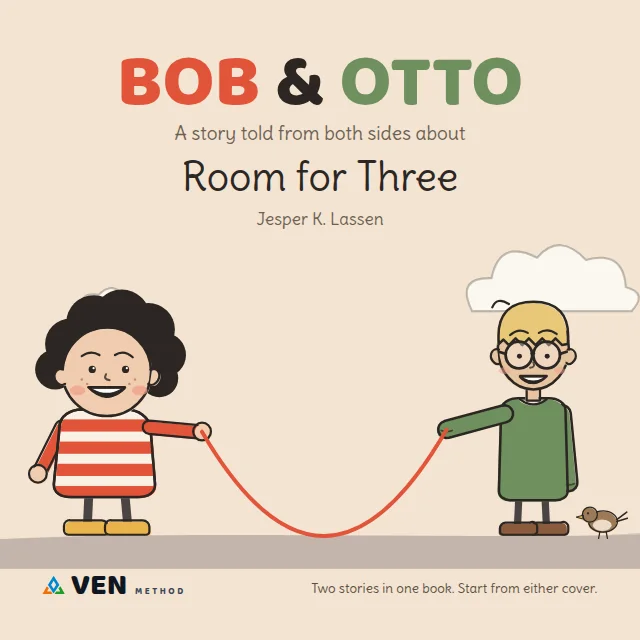
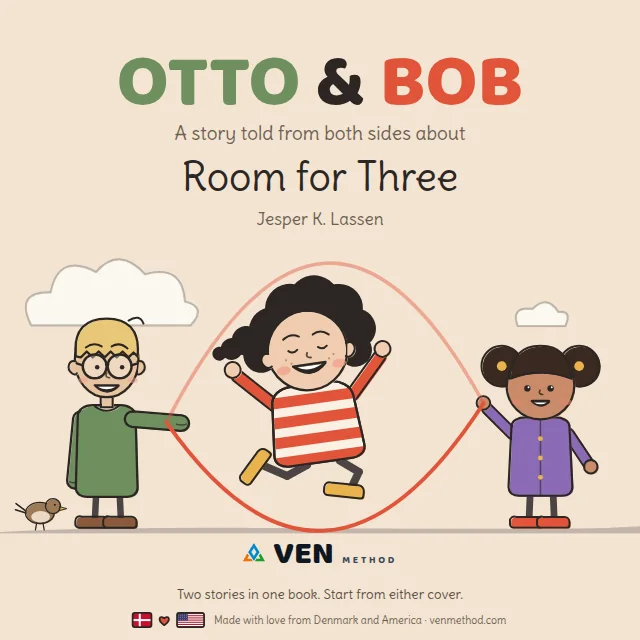
A new girl arrives at school. Bob sees Otto with her, counts two, and walks to the wall on his own. Otto spent the whole morning telling her about Bob. Room for Three is about the arithmetic children do in playgrounds, and why counting is not the same as asking.
Hear it read aloud
The whole book, read aloud, in 4 min 55 s. Press play and it plays right here. Read it Bob’s way first, then turn it over for Otto’s; the video goes front to back.
The narration in these videos is an AI-generated voice. The words and every picture are Jesper K. Lassen’s own work and are protected by copyright (© 2026 Jesper K. Lassen; published by VEN Method). They may be watched and shared freely; copying or reusing the illustrations or text requires written permission.
At a glance
- Ages
- 4 to 8 · read-aloud from about four, early readers alone
- What it practices
- Asking instead of counting: a new friend does not replace an old one
- The misreading
- A friend with someone new, taken as being replaced
- Opens and closes on
There’s always room for you.
- Length
- About 127 words in all · 20 lines, one per page · 32-page paperback, 8.5 × 8.5 in
- SEL competencies (CASEL)
- Social awareness (perspective-taking) · Relationship skills (inclusion, making friends) · Self-awareness (jealousy and fear of being left out)
- Editions
- Paperback $8.99 (ISBN 979-8-9979707-2-7) · Kindle $2.99 · Spanish: Sitio para tres, paperback (ISBN 979-8-9979707-7-2) and Kindle · buy direct or find a store
The two sides
Read from the front, it is Bob’s story. Turn the book over and read the same pages from the back, and it is Otto’s. Neither boy is wrong about everything, and neither is right about everything.
Bob’s side
- What he believes
- Otto has a new best friend. Two is a pair, so there is no room for him.
- What he gets right
- Otto really did spend all morning with her. Bob is not imagining it.
- What he misses
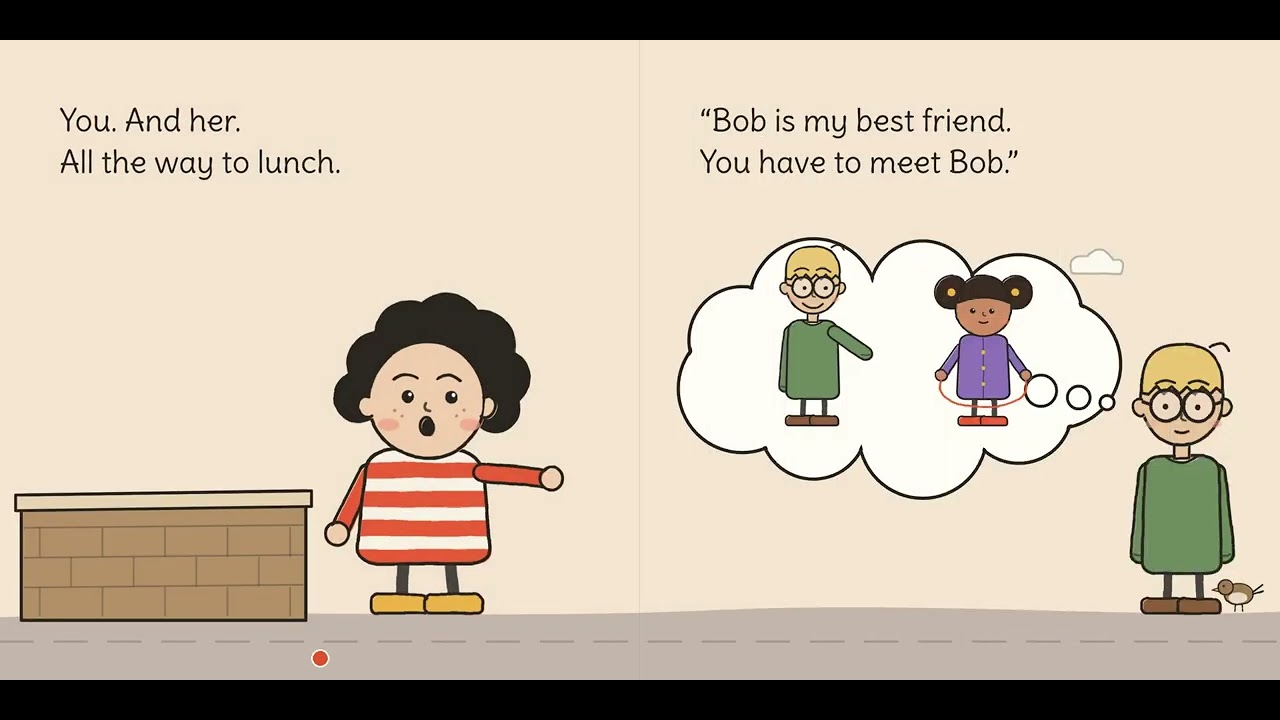
- Otto was telling her about Bob the whole time:
“Bob is my best friend. You have to meet Bob.”
And jump rope needs three.
In his own words, from his page in the book: I count things. Steps. Birds. Friends.
I’m learning that counting is not the same as asking.
Otto’s side
- What he believes
- Bob will be glad. Now there are enough of them to jump rope.
- What he gets right
- There was always room for Bob. He came after him with the rope.
- What he misses
- From the outside, a morning with someone new looks like leaving. He did not say the important part first.
In his own words, from his page in the book: When I make a new friend, I want my old friend to meet them.
I’m learning to say that part first.
The psychology behind it
Many young children treat friendship as if it had a fixed number of places. When a best friend spends time with someone new, the simplest explanation a child has is subtraction: if they are together, I am out. Bob does exactly that. On his own page he says I count things. Steps. Birds. Friends.
In the story he counts two, decides there is no room, and leaves.
What Bob is missing is information only Otto has: what Otto was saying all morning. Understanding that another person can know something you do not, and act on it, is the core of what psychologists call theory of mind. Children typically come to pass classic false-belief tasks somewhere between about three and five1. Room for Three gives that new ability something to work on: the reader, holding both sides of the book, knows more than either boy, and can see exactly where Bob’s count went wrong.
Research on how children learn to think about other minds points to conversation as a key ingredient. In a training study, three-year-olds who took part in short sessions of “perspective-shifting” talk about objects that looked like one thing but were another improved on false-belief tasks, while children who saw the same objects without the talk did not2. Two months of conversations about mental-state words after story readings improved four-year-olds’ false-belief understanding in another randomized study3. The questions at the end of this page are built for that kind of conversation.
The book’s answer to Bob’s fear is not reassurance. It is a jump rope. Two people turn it and one person jumps, so a game for two needs a third. Two turning. One jumping. That one is you.
A child does not have to accept a general rule about friendship (“there is always room for more”) on trust. The object makes the rule visible.
How the words do it
The book counts the same scene twice. On Bob’s page, the whole thought is one word: Two.
On Otto’s page, the same picture is counted differently: Two turning. One jumping. That one is you.
Same playground, same children, a different sum.
The middle of the book turns on the rope. Bob: Two ends. No room in the middle.
Otto: The middle was always for you.
A rope has two ends and one middle, and the middle is where the jumper goes. Bob sees the ends as the whole rope; Otto sees the space between them as Bob’s place.
Spread six shows how the two directions do different work. Forward, I walked to the wall on my own.
is answered by I came after you with the rope.
An action, then a reply. Backward, Otto’s line comes first, and Bob’s answers it: Otto came after him with the rope, because Bob had walked to the wall on his own. One way round is what happened. The other way round is why.
As in every book in the series, the opening and closing spreads carry the same line on both pages: There’s always room for you.
Two.
Two turning. One jumping. That one is you.
What the pictures do
The jump rope is the object the whole story turns on: two ends, one middle, three children. Anna, the new girl, has a name that reads the same backwards, like Bob’s and Otto’s. The three children only ever appear together on the back cover, never inside the story, so the moment the trio forms belongs to the reader’s imagination. The sparrow marks every one of Otto’s pages.
Questions to ask after reading
Open questions work best: there is no single right answer, and the point is for the child to explain what they think. Ask a few, not all.
After Bob’s side
- What did Bob count?
- Why did Bob walk to the wall by himself?
- What did Bob think Otto had?
After turning it over
- What was Otto telling the new girl all morning?
- Why did Otto come after Bob with the rope?
- How many people do you need to play jump rope?
After both sides
- Can you have a new friend and an old friend at the same time?
- What could Bob have asked instead of counting?
- Has a friend ever played with someone new? How did it feel? What happened next?
In a classroom or counseling session
If you have a jump rope, bring it. Read Bob’s side and stop at You have a new best friend.
Ask: is that true? Turn the book over for Otto’s side, then show with the rope why the game needs three. Finish with the “both sides” questions. Ten to fifteen minutes.
Ordering for a class or a school? Class sets are quoted directly: see orders and bulk copies.
Questions people ask about Room for Three
What age is Room for Three for?
Ages 4 to 8. About 130 words in the whole book, so early readers can read it themselves.
What is Room for Three about?
Bob sees his best friend Otto with a new girl at school and decides he has been replaced. From Otto’s side, he spent the morning telling her about Bob, and they needed three people to jump rope.
Who is Anna?
The new girl in Book 3. Like Bob and Otto, her name reads the same backwards.
Is there a Spanish edition?
Yes: Sitio para tres (Bob y Otto, libro 3), on Kindle. The Spanish paperback is coming.
Can I order class sets?
Yes. Email jesper@danishmentalist.com for a quote, or see bobandotto.com/orders/.
Sources
- Wellman, H. M., Cross, D., & Watson, J. (2001). Meta-analysis of theory-of-mind development: The truth about false belief. Child Development, 72(3), 655–684. https://doi.org/10.1111/1467-8624.00304
- Lohmann, H., & Tomasello, M. (2003). The role of language in the development of false belief understanding: A training study. Child Development, 74(4), 1130–1144. https://doi.org/10.1111/1467-8624.00597
- Ornaghi, V., Brockmeier, J., & Grazzani, I. (2011). The role of language games in children’s understanding of mental states: A training study. Journal of Cognition and Development, 12(2), 239–259. https://doi.org/10.1080/15248372.2011.563487
- CASEL. What is the CASEL framework? Collaborative for Academic, Social, and Emotional Learning. https://casel.org/fundamentals-of-sel/what-is-the-casel-framework/
- Preston, D. (2026, September 24). Children’s book review: The Bob & Otto series (+ author interview). debpreston.com. https://debpreston.com/bob-and-otto-review/