Bob & Otto · Book 2 · How it works
The Laugh: the psychology behind the book
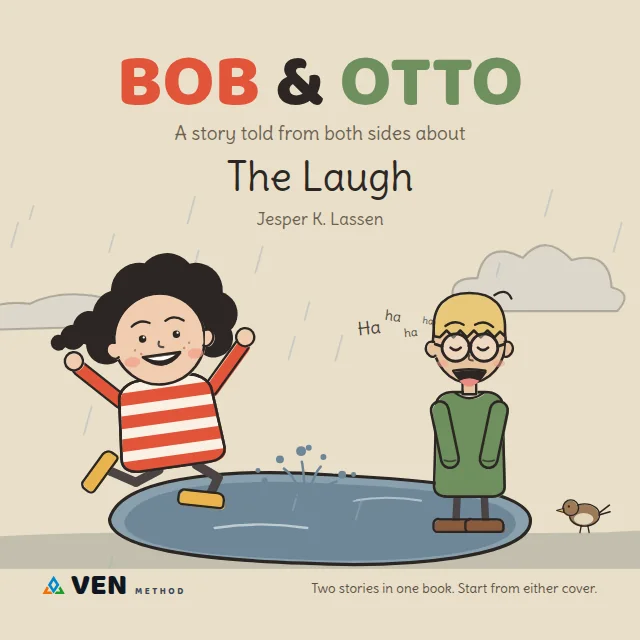
Bob falls in a puddle and his best friend laughs. It looks like being laughed at. From Otto’s side of the book, the laugh means something else entirely. The Laugh is about a sound that can mean many things, and what happens when you turn a guess into a fact.
Hear it read aloud
The whole book, read aloud, in 4 min 55 s. Press play and it plays right here. Read it Bob’s way first, then turn it over for Otto’s; the video goes front to back.
The narration in these videos is an AI-generated voice. The words and every picture are Jesper K. Lassen’s own work and are protected by copyright (© 2026 Jesper K. Lassen; published by VEN Method). They may be watched and shared freely; copying or reusing the illustrations or text requires written permission.

At a glance
- Ages
- 4 to 8 · read-aloud from about four, early readers alone
- What it practices
- Knowing that a laugh can mean many things, and asking which one
- The misreading
- A friend’s laugh, taken as laughing at you
- Opens and closes on
I like laughing with you.
- Length
- About 105 words in all · 20 lines, one per page · 32-page paperback, 8.5 × 8.5 in
- SEL competencies (CASEL)
- Social awareness (reading others’ intentions) · Self-awareness (embarrassment and hurt) · Relationship skills (repair)
- Editions
- Paperback $8.99 (ISBN 979-8-9979707-1-0) · Kindle $2.99 · Spanish: La risa, paperback (ISBN 979-8-9979707-6-5) and Kindle · buy direct or find a store
The two sides
Read from the front, it is Bob’s story. Turn the book over and read the same pages from the back, and it is Otto’s. Neither boy is wrong about everything, and neither is right about everything.
Bob’s side
- What he believes
- Otto is laughing at him for falling in the puddle.
- What he gets right
- Otto is laughing, loudly, right when Bob is wet and embarrassed. Anyone might think the same.
- What he misses
- Otto fell in the same puddle yesterday. Nobody was there to laugh with him. He is laughing at himself.
In his own words, from his page in the book: I like puddles from above. Not from inside.
I’m learning that a laugh can mean lots of things.
Otto’s side
- What he believes
- Bob will know the laugh is friendly. It obviously is, from where Otto is standing.
- What he gets right
- He was not laughing at Bob, and he proves it by sitting down in the puddle beside him.
- What he misses
- From the inside of a puddle, a laugh sounds like it is aimed at you. He did not say why he was laughing.
In his own words, from his page in the book: I laugh before I can stop it. I’m practicing the stopping.
I’m learning to say why I’m laughing, out loud.
The psychology behind it
Laughter is an ambiguous cue. The same sound can mean joy, relief, nerves, affection or mockery, and the listener has to decide which, usually in a second and often while embarrassed. Research on social information processing describes this decision as the interpretation step that sits between noticing a cue and responding to it1. Children who tend to resolve ambiguous moments with a hostile reading get into more conflict with peers; across 41 studies, hostile attribution of intent was consistently linked to aggressive behavior2.
The good news in that research is that interpretation can be practiced. The BrainPower program taught elementary-school boys to tell accidental, helpful and hostile intentions apart from social cues, and their hostile attributions and endorsement of retaliation fell compared with control groups3. Those children were older than this book’s readers and were chosen for aggression, so the comparison is about the mechanism, not a promise of the same result. But the skill being trained is exactly the one Bob is missing: considering that a cue might not mean what it first seems to mean.
The book names Bob’s mistake precisely, and gently. Otto’s page says: You said it like a fact.
You never asked.
That is the move every child (and adult) makes: an interpretation hardens into a fact before anyone has checked it. Later Bob says the same words about himself, I said it like a fact. I never asked.
The repair is not an apology speech. It is a recognition, in the same words his friend used.
Otto’s side carries a second, quieter lesson. He was laughing because yesterday he took the same jump into the same puddle and Nobody laughed.
That was the worst part.
A laugh shared with a friend turns an embarrassing fall into a good story; a fall with nobody there is just lonely. The book shows a child that laughing with someone and laughing at someone sound alike, and that the difference is who is invited in.
How the words do it
One hinge sits near the end, a two-line exchange: Yesterday, nobody.
/ Today, you.
Because the book is read in both directions, Bob’s line Yesterday, nobody.
has two different neighbors. Forward, it is followed by Otto’s Today, you.
That is a turn toward friendship: yesterday there was no one, today there is you. Backward, the line that follows it is Otto’s That was the worst part.
Now the same two words become the loneliness underneath the laugh.
The middle of the book is Otto’s Not at you. At me.
Forward, it comes just after Otto sits down in the puddle, so it explains the gesture. Backward, it arrives before the reader has reached Bob’s jump, so the second reader learns halfway through what the first reader only found out near the end.
Besides the printed lines Ha?
and Ha. Ha. Ha. Ha.
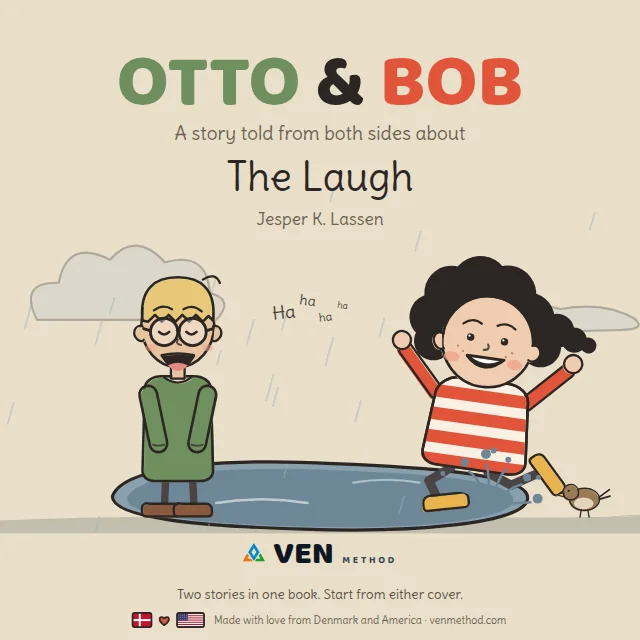
, the laughter is lettered big into the pictures: on the covers, on the first and last spreads, and on the spread right after Bob lands in the puddle. The same letters look like fun on the cover and like they are aimed at Bob on that spread. Nothing about them changes except what the reader knows.
Yesterday, nobody. → Today, you.
Yesterday, nobody. → That was the worst part.
What the pictures do
The puddle is where the story happens, and the boys end up in it together. Bob is drawn wet and hurt but never angry. The sparrow sits on every one of Otto’s pages, so a pre-reader can follow which boy they are with. The laughter is lettered into the pictures, so a child can point at it and ask: is that a nice laugh or a mean one?
Questions to ask after reading
Open questions work best: there is no single right answer, and the point is for the child to explain what they think. Ask a few, not all.
After Bob’s side
- Why did Bob think Otto was laughing at him?
- How do you feel when someone laughs and you don’t know why?
- What did Bob say? Did he ask, or did he decide?
After turning it over
- Who was Otto really laughing at?
- What happened to Otto yesterday at the same puddle?
- Why did Otto sit down in the puddle next to Bob?
After both sides
- Can a laugh mean different things? What kinds of laughs do you know?
- What could Bob ask Otto when he hears him laugh?
- What could Otto say so Bob knows the laugh is friendly?
In a classroom or counseling session
Before reading, ask the class to show a laugh that is kind and a laugh that is unkind. Read Bob’s side and stop at You are laughing at me.
Ask what they think. Turn the book over for Otto’s side, then use the “both sides” questions. Ten minutes.
Ordering for a class or a school? Class sets are quoted directly: see orders and bulk copies.
Questions people ask about The Laugh
What age is The Laugh for?
Ages 4 to 8, as a read-aloud from about four. The story uses about 105 words, plus laughter lettered into the pictures.
What is The Laugh about?
Bob falls in a puddle and thinks his best friend Otto is laughing at him. Turned over, the book shows Otto was laughing at himself: he fell in the same puddle yesterday and nobody laughed with him.
What does the book teach?
That a laugh can mean many things, and that it helps to ask before deciding. It does this through the story, without stating a moral.
Is there a Spanish edition?
Yes: La risa (Bob y Otto, libro 2), on Kindle. The Spanish paperback is coming.
Can I order class sets?
Yes. Email jesper@danishmentalist.com for a quote, or see bobandotto.com/orders/.
Sources
- Crick, N. R., & Dodge, K. A. (1994). A review and reformulation of social information-processing mechanisms in children’s social adjustment. Psychological Bulletin, 115(1), 74–101. https://scholars.duke.edu/individual/pub658165
- Orobio de Castro, B., Veerman, J. W., Koops, W., Bosch, J. D., & Monshouwer, H. J. (2002). Hostile attribution of intent and aggressive behavior: A meta-analysis. Child Development, 73(3), 916–934. https://doi.org/10.1111/1467-8624.00447
- Hudley, C., Graham, S., & Taylor, A. (2007). Reducing aggressive behavior and increasing motivation in school: The evolution of an intervention to strengthen school adjustment. Educational Psychologist, 42(4). (Describes the BrainPower attribution program, first reported in Child Development, 1993.) https://escholarship.org/content/qt22b6b1gs/qt22b6b1gs.pdf
- CASEL. What is the CASEL framework? Collaborative for Academic, Social, and Emotional Learning. https://casel.org/fundamentals-of-sel/what-is-the-casel-framework/
- Preston, D. (2026, September 24). Children’s book review: The Bob & Otto series (+ author interview). debpreston.com. https://debpreston.com/bob-and-otto-review/