Bob & Otto · Book 5 · How it works
In Otto’s Shoes: the psychology behind the book
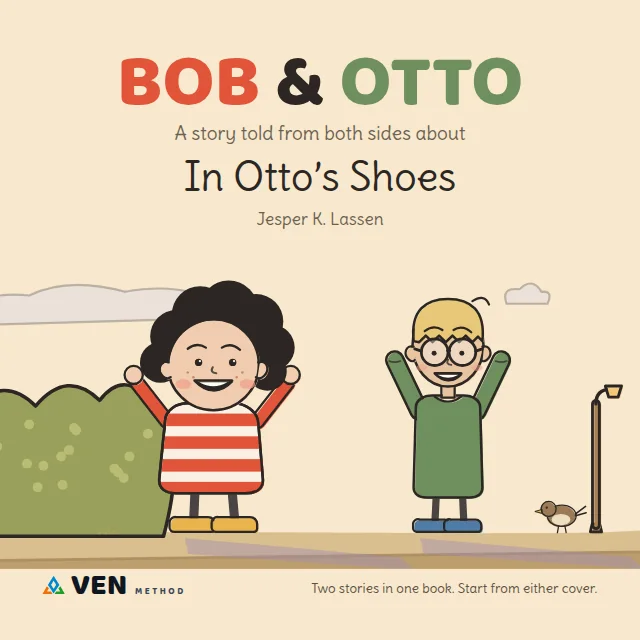
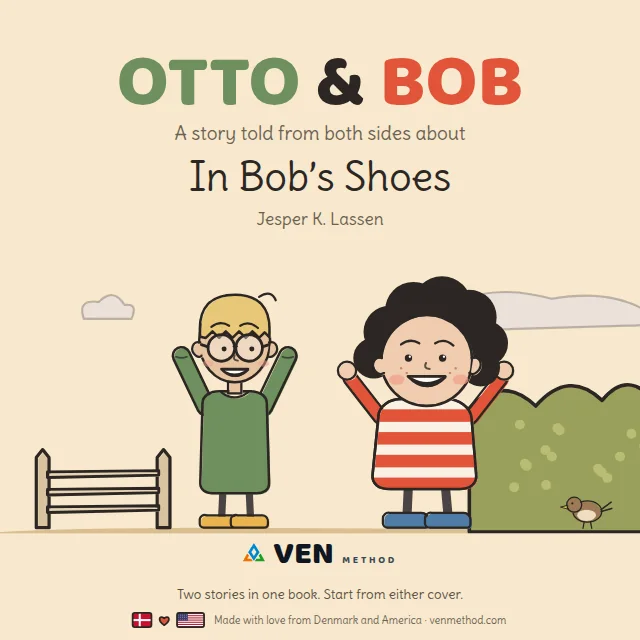
Otto’s new shoes hurt, and Bob cannot tell why. Halfway home they swap. In Otto’s Shoes takes the old saying about empathy, walking in someone else’s shoes, and makes it literal enough for a four-year-old.
At a glance
- Ages
- 4 to 8 · read-aloud from about four, early readers alone
- What it practices
- Understanding a friend’s hurt from the inside, and asking before fixing
- The misreading
- A friend’s pain that cannot be seen from outside
- Opens and closes on
I like your shoes.
- Length
- About 87 words in all · 22 lines, one per page · 34-page paperback, 8.5 × 8.5 in
- SEL competencies (CASEL)
- Social awareness (empathy) · Relationship skills (asking for and offering help) · Self-awareness (saying “it hurts”)
- Editions
- Paperback $8.99 (ISBN 979-8-9979707-4-1) · Kindle $2.99 · Spanish: En los zapatos de Otto, paperback (ISBN 979-8-9979707-9-6) and Kindle · buy direct or find a store
The two sides
Read from the front, it is Bob’s story. Turn the book over and read the same pages from the back, and it is Otto’s. Neither boy is wrong about everything, and neither is right about everything.
Bob’s side
- What he believes
- He can work out what is wrong by looking: a stone, or shoes too small. Then he can fix it.
- What he gets right
- Something really is wrong. Otto keeps stopping to look down.
- What he misses
You can’t tell from out there.
He only knows when he is wearing them.
In his own words, from his page in the book: When my friend hurts, I want to fix it right away.
I’m learning to ask what it feels like first.
Otto’s side
- What he believes
- It is his problem. The shoes are new; they will stop hurting.
- What he gets right
- Some things cannot be seen from the outside.
- What he misses
- Keeping a hurt to yourself makes everyone guess.
In his own words, from his page in the book: I keep things to myself when they hurt.
I’m learning to say “it hurts” before anyone has to guess.
The psychology behind it
Empathy is often taught to children as an instruction: imagine how they feel. For a young child that is hard, because it asks them to simulate an experience they have never had. In Otto’s Shoes takes the other route. Bob does not imagine the pain; he puts on the shoes. There is some evidence for learning about others through your own experience: in one training study, infants who had worn a blindfold themselves began to understand that a blindfolded adult could not see1. That is a long way from a five-year-old on a walk home, so treat it as an analogy, but the principle is the one this book is built on: experience first, then understanding.
The book also separates two impulses that children (and adults) often run together: wanting to help, and understanding what is wrong. Bob’s own page says it: When my friend hurts, I want to fix it right away.
In the story he guesses (A stone in it? Or too small?
) and Otto answers with the line the whole book turns on: You can’t tell from out there.
Deb Preston described the lesson as Bob learning to empathize before getting to work fixing it2.
Otto has the matching lesson. He keeps the hurt to himself, so Bob has to guess. In social-emotional learning terms, the book pairs a social-awareness skill (understanding someone else’s experience) with a relationship skill (saying what you need)3. Neither boy can solve it alone.
How the words do it
This book is built as a mirror. After the swap in the middle, the same lines come back in reverse order, now spoken by the other boy. Before the swap, Bob asks Does it hurt?
and Otto answers Every step.
After it, Bob is the one who says Every step.
and Otto asks Does it hurt?
Before, Bob says Swap with me.
and Otto replies You’ll see.
After, Bob says You’ll see.
and Otto offers Swap with me.
That means nearly every line of dialogue is said once by each boy, and whichever cover you start from, the boy you are walking with is the one who notices, guesses, cannot tell, offers to swap, and then feels it. Whichever way you read it, you watch your friend hurt first, and then you feel it yourself.
It is the shortest text in the series, under ninety words. The covers carry the same exchange as the shoes: the front reads In Otto’s Shoes, the back In Bob’s Shoes. Both ends of the book open on the same compliment, I like your shoes.
It means something different once you know what those shoes feel like.
Does it hurt? → Every step.
Every step. → Does it hurt?
What the pictures do
The shoes are the most important thing in every picture, and the reader always knows whose feet they are on. Bob’s yellow boots and Otto’s new shoes change places at the exact middle of the book. The sparrow keeps to Otto’s pages, so the reader can track the boys even after their shoes have swapped.
Questions to ask after reading
Open questions work best: there is no single right answer, and the point is for the child to explain what they think. Ask a few, not all.
After Bob’s side
- What did Bob notice about Otto?
- What did Bob guess was wrong?
- Why couldn’t Bob tell from the outside?
After turning it over
- Why didn’t Otto say his shoes hurt?
- What did Otto offer Bob?
- How did each boy find out what the other one felt?
After both sides
- Have you ever had a hurt that nobody could see?
- What could you say when something hurts?
- What does it mean to be “in someone’s shoes”?
In a classroom or counseling session
If the children are happy to, swap one shoe with a partner and walk across the room before reading. Read Bob’s side, then turn the book over. Ask what changed when the boys swapped. Ten to fifteen minutes.
Ordering for a class or a school? Class sets are quoted directly: see orders and bulk copies.
Questions people ask about In Otto’s Shoes
What age is In Otto’s Shoes for?
Ages 4 to 8. It is the shortest book in the series, under 90 words, so early readers can manage it alone.
What is In Otto’s Shoes about?
Otto’s new shoes hurt and Bob cannot tell what is wrong. They swap shoes on the way home, and each boy feels what the other felt.
Why does the back cover say In Bob’s Shoes?
Each cover names the boy whose shoes you walk in. After the middle of the book, the boys say each other’s lines, just as they wear each other’s shoes.
Is there a Spanish edition?
Yes: En los zapatos de Otto (Bob y Otto, libro 5), on Kindle. The Spanish paperback is coming.
Can I order class sets?
Yes. Email jesper@danishmentalist.com for a quote, or see bobandotto.com/orders/.
Sources
- Meltzoff, A. N., & Brooks, R. (2008). Self-experience as a mechanism for learning about others: A training study in social cognition. Developmental Psychology, 44(5), 1257–1265. https://doi.org/10.1037/a0012888
- Preston, D. (2026, September 24). Children’s book review: The Bob & Otto series (+ author interview). debpreston.com. https://debpreston.com/bob-and-otto-review/
- CASEL. What is the CASEL framework? Collaborative for Academic, Social, and Emotional Learning. https://casel.org/fundamentals-of-sel/what-is-the-casel-framework/