Bob & Otto · How it works
Two sides, one book: the psychology and the craft of Bob & Otto
Every Bob & Otto book is one small misunderstanding between two best friends, told so that the same printed words give you one boy’s side when you read from the front and the other boy’s side when you turn the book over. This page explains the thinking behind that design, for children aged four to eight: the psychology it draws on, how the text is made, what the pictures are doing, and how to talk about the books afterwards.
One habit, practiced five ways
The books practice one habit: before you decide what someone meant, ask how they heard it. Each book isolates one kind of social cue that children commonly misread, and shows it from both sides:
- Half a Sentence: an overheard fragment, taken as the whole message.
- The Laugh: a laugh, taken as laughing at you.
- Room for Three: a friend with someone new, taken as being replaced.
- Goodnight, Otto: a silence, taken as anger.
- In Otto’s Shoes: a hurt you cannot see from the outside.
In every book, both boys are partly right. Bob is never wrong about what he saw or heard, only about what it meant. Otto never means harm, but he always leaves out the part that would have helped. Nobody is the villain. The misunderstanding is the problem, and it belongs to both of them.
The psychology
Misreading intentions
Before a child responds to anything a friend does, they have to interpret it. In the social information-processing model developed by Nicki Crick and Kenneth Dodge, interpretation is a step of its own, between noticing a cue and choosing a response1. Children who habitually resolve ambiguous cues with a hostile reading get into more conflict: a meta-analysis of 41 studies and more than 6,000 participants found a robust association between hostile attribution of intent and aggressive behavior2. Interpretation can also be trained. The BrainPower program taught elementary-school boys to tell accidental, helpful and hostile intentions apart, and their hostile attributions fell compared with control groups3. Those were older children, selected for aggression, so the lesson for younger readers is about the mechanism rather than a promised outcome. But the mechanism is exactly what every Bob & Otto book slows down and shows: Bob reads a cue, decides what it means, and acts, and the other side of the book shows him the reading he skipped.
Why ages four to eight
Between about three and five, most children come to pass classic false-belief tasks: they understand that someone can believe something that is not true4. The books are written for the years just after that shift, when a child can hold the idea that a belief can be wrong and is ready for the harder version: my belief can be wrong, and my friend may know something I don’t.
Discovering, not being told
The books never state a moral and never use the word “perspective.” That is a design choice with some evidence behind it. In a study of four-year-olds who heard about 70 picture books over four weeks, texts that spelled out characters’ mental states increased the children’s use of mental-state words, but children who had to infer those states from the story did better on false-belief tasks5. It is one small study, so it is suggestive rather than settled. As picture-book author Mo Willems put it: For me a good book is a question, not an answer.
16
Turning the book over
Children’s understanding of other minds grows through talk that sets two perspectives side by side. In one training study, three-year-olds who took part in short sessions of “perspective-shifting” conversation improved on false-belief tasks, while children who saw the same objects without that conversation did not6. In another, two months of conversations about mental-state words after story readings improved four-year-olds’ false-belief understanding7. Parents who talk more about thoughts, knowledge and feelings tend to have children with better social understanding, though that evidence is correlational8. A Bob & Otto book builds the perspective shift into the object itself: the child physically turns the book over to get the other side, and the conversation starts there.
The questions afterwards
Every book’s title page ends with the same instruction to the grown-up: then ask your reader what the other boy meant.
Asking open questions during and after shared reading is the core of dialogic reading, which the What Works Clearinghouse rated as having positive effects on young children’s oral language9. That evidence is about language, not perspective-taking, but it is the same habit: the adult asks, the child explains. Each book page on this site has a set of questions for after Bob’s side, after Otto’s side, and after both.
Where it fits in social-emotional learning
In the CASEL framework, the books sit mainly in social awareness (understanding others’ perspectives and empathizing with them) and relationship skills (communicating clearly and resolving conflicts constructively)10. A large meta-analysis of school-based social-emotional learning programs found gains in social skills, behavior and academic performance11; the books are not a program, but they are built to be used inside one, in about ten minutes.
The form: one text, read both ways
The text of each book is a reverse poem, or “reverso,” a form the poet Marilyn Singer invented and introduced in Mirror Mirror (2010). Her rule is that the reversed poem may change only punctuation and capitalization, and it has to say something different
12. She has listed reversos among the hardest forms she has written12, and her last tip for anyone trying one is Don’t get discouraged — reversos are hard to write.
13
The Bob & Otto books add constraints a single poem does not have:
- The text is a duet. Every spread has one line for each boy, Bob on the left and Otto on the right, and the lines keep their owners in both directions.
- Not even the punctuation changes: the book is printed once, so both readings use exactly the same marks.
- Each direction has to be a real story with its own question, not the first story rewound. Forward, a book is usually a sequence of events; backward, the same lines become a chain of reasons.
- The first and last spreads carry the same line on both pages (
You are my best friend.
Are you nearly asleep?
), so every reading opens and closes in the same place. - Some lines are left deliberately unfinished, so that the line after them completes them, and because the book is read both ways, each has two different completions. In Goodnight, Otto,
All the way down the middle—
is followed forward byOne roof over the two of us.
and backward byI stayed on my half.
- In three of the books, one line hands a boy’s side over (
Now you hear my side.
), placed one spread from the end, so it is the last line before the closing spread in one direction and the first line after the opening spread in the other. - All of this has to fit in fewer than 135 words, one short line per page, for a child of four.
Working inside rules like these has a long history in literature. The French group Oulipo, founded in 1960 by Raymond Queneau and François Le Lionnais, made a practice of “self-restricting” methods of writing14; Queneau’s Exercices de style tells one small incident again and again in different ways. Psychology research has found that a well-chosen constraint can make writing more creative rather than less, as in Dr. Seuss’s Green Eggs and Ham, written with just fifty different words15. The constraint here serves a single purpose: when the words cannot change, the only thing left to change is the point of view.
The pictures
In a picture book, words and pictures can say the same thing, add to each other, or pull against each other17. In Bob & Otto, the pictures follow a few fixed rules so that they stay true whichever way the book is read:
- The sparrow. A sparrow sits on every one of Otto’s pages and never on Bob’s. A child who cannot read yet always knows whose side they are on, and the books tell the reader where to start:
Start on the page the sparrow is sitting on.
- Bob is never drawn angry, only puzzled, hurt or careful. Both boys stay likeable, so the reader never has to take sides against either of them.
- One moment per spread, so that each picture still makes sense when the reader arrives at it from the other direction.
- The same two boys, the same type, a new world. Characters and lettering are identical across the series; the setting and color change with each story, from the fence of Half a Sentence to the night-blue tent of Goodnight, Otto.
- Each boy has his own page at his end of the book: a few short lines in his own voice, including what he is learning (
I hear things fast. Sometimes faster than they were said.
I say things slowly. Sometimes too slowly.
).
Why so few words
Most picture books run to several hundred words. A Bob & Otto book uses about a hundred, one line per page. Deb Preston noticed it in her review: …these books say a lot in just a few simple words.
18 The brevity is what makes a second reading possible at bedtime, and what lets a child read the book alone once they can. It is also what the form demands: every word has to work twice, so there is no room for a word that only works once.
What readers have said
Deb Preston’s children’s book review called the series a thought-provoking, discussion-inducing series that kids and adults alike are sure to enjoy
and summed up the format: You’re seeing both sides of the story figuratively, while reading it from both sides of the book literally.
18 Michelle Marcotte reviewed the series on her YouTube channel, Great Books for Kids19. As of October 2026, every book in the series is rated 5 out of 5 stars on Amazon.
Using the books
- Read Bob’s side from the front cover, one spread at a time.
- Stop before you turn the book over and ask: what do you think the other boy meant?
- Turn the whole book over and read Otto’s side, starting on the page with the sparrow.
- Ask the “both sides” questions from the book’s page on this site. Ten minutes in all.
For a whole class, the free print-at-home mini books (The Swing and We Forgot It Again) work the same way on a single folded sheet. For class sets of the real books, see orders and bulk copies.
The five books, one by one
Each book has its own page: Bob’s side and Otto’s side, the psychology behind it, how the text does it, and questions to ask after reading.
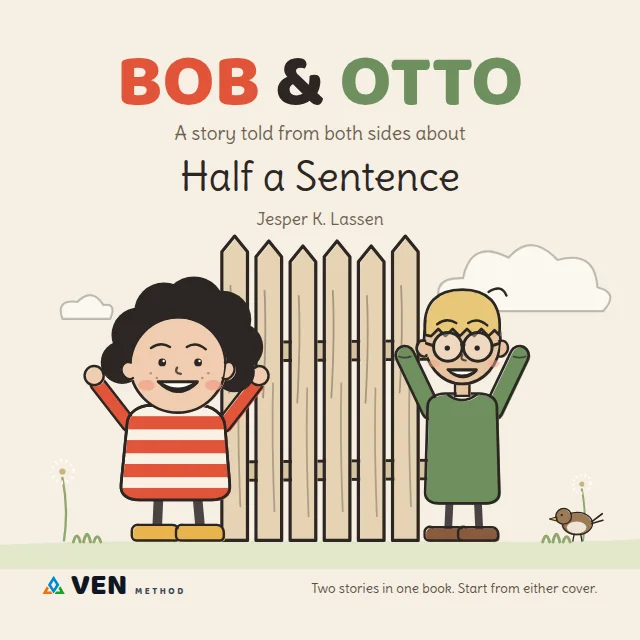 Book 1: Half a Sentence — an overheard half-sentence, taken as the whole message
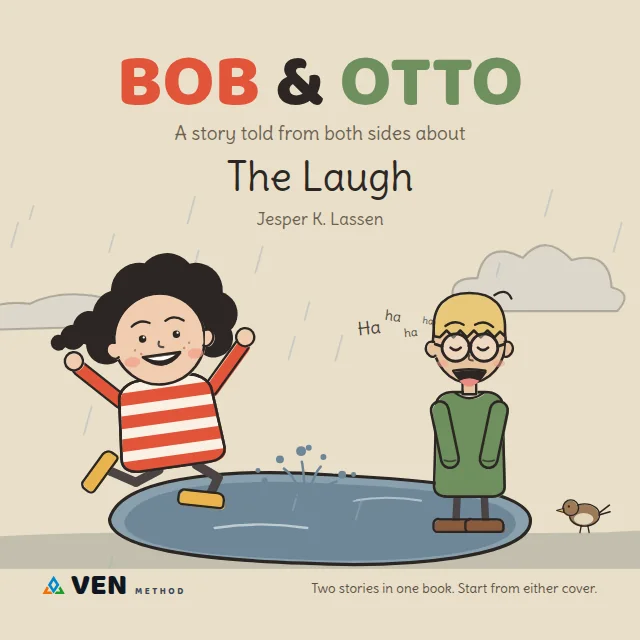 Book 2: The Laugh — a friend’s laugh, taken as laughing at you
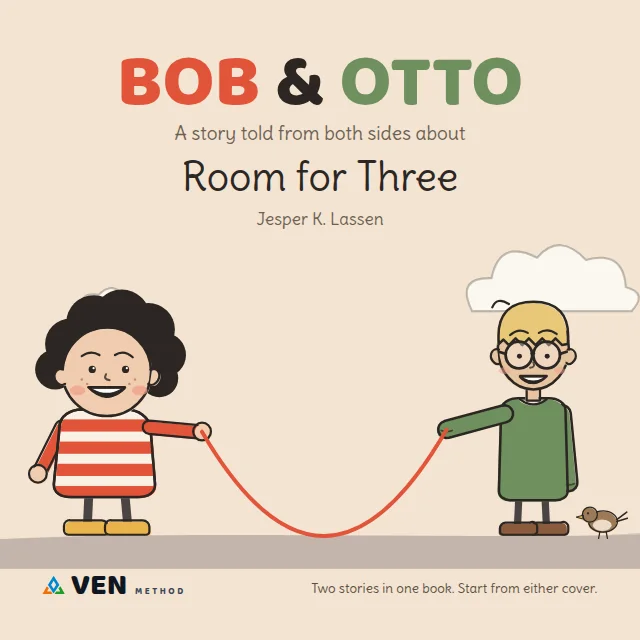 Book 3: Room for Three — a friend with someone new, taken as being replaced
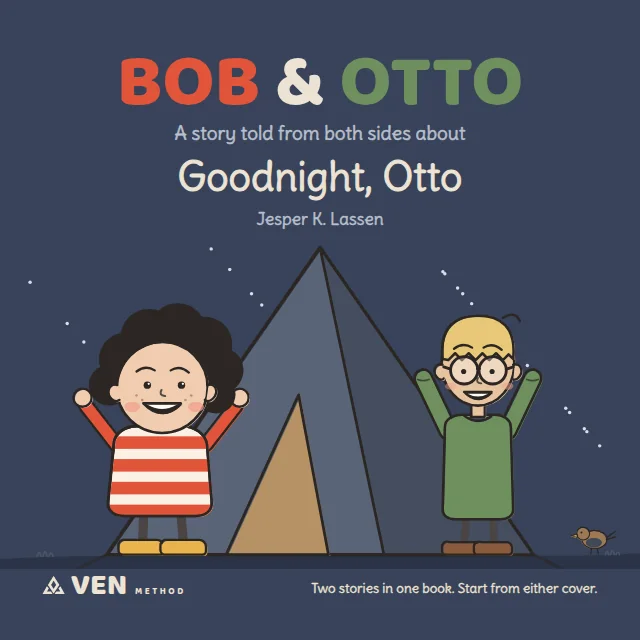 Book 4: Goodnight, Otto — a friend’s silence, taken as anger
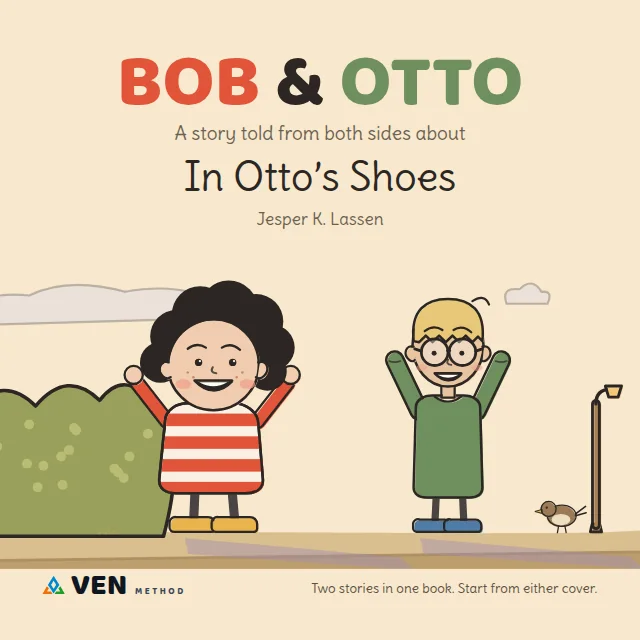 Book 5: In Otto’s Shoes — a friend’s pain that cannot be seen from outside
Questions people ask
What is a two-way picture book?
A book printed once that tells one character’s story when read front to back and another character’s story when the book is turned over and the same pages are read back to front. Bob & Otto is a series of five.
Is Bob & Otto a palindrome book?
No. A palindrome reads the same letter by letter in both directions. Bob & Otto reverses the order of the lines, not the letters: a reverso, or reverse poem, written as a duet between two characters.
What age are the books for?
Ages 4 to 8. They work as read-alouds from about four, and early readers can read them alone: each book uses fewer than 135 words.
What research are the books based on?
The books are designed around established research on how children interpret others’ intentions, develop theory of mind and learn through conversation during shared reading. The sources are listed on this page.
Who wrote the books?
Jesper K. Lassen, a Danish mentalist and the founder of VEN Method, a social-emotional learning company. The books are published by VEN Method.
How do I order class sets?
Email jesper@danishmentalist.com with the titles, quantities and delivery address for a quote. Bookshops and libraries can also order the paperbacks through Ingram by ISBN.
Sources
- Crick, N. R., & Dodge, K. A. (1994). A review and reformulation of social information-processing mechanisms in children’s social adjustment. Psychological Bulletin, 115(1), 74–101. https://scholars.duke.edu/individual/pub658165
- Orobio de Castro, B., Veerman, J. W., Koops, W., Bosch, J. D., & Monshouwer, H. J. (2002). Hostile attribution of intent and aggressive behavior: A meta-analysis. Child Development, 73(3), 916–934. https://doi.org/10.1111/1467-8624.00447
- Hudley, C., Graham, S., & Taylor, A. (2007). Reducing aggressive behavior and increasing motivation in school: The evolution of an intervention to strengthen school adjustment. Educational Psychologist, 42(4). (Describes the BrainPower attribution program, first reported in Child Development, 1993.) https://escholarship.org/content/qt22b6b1gs/qt22b6b1gs.pdf
- Wellman, H. M., Cross, D., & Watson, J. (2001). Meta-analysis of theory-of-mind development: The truth about false belief. Child Development, 72(3), 655–684. https://doi.org/10.1111/1467-8624.00304
- Peskin, J., & Astington, J. W. (2004). The effects of adding metacognitive language to story texts. Cognitive Development, 19(2), 253–273. https://doi.org/10.1016/j.cogdev.2004.01.003
- Lohmann, H., & Tomasello, M. (2003). The role of language in the development of false belief understanding: A training study. Child Development, 74(4), 1130–1144. https://doi.org/10.1111/1467-8624.00597
- Ornaghi, V., Brockmeier, J., & Grazzani, I. (2011). The role of language games in children’s understanding of mental states: A training study. Journal of Cognition and Development, 12(2), 239–259. https://doi.org/10.1080/15248372.2011.563487
- Tompkins, V., Benigno, J. P., Kiger Lee, B., & Wright, B. M. (2018). The relation between parents’ mental state talk and children’s social understanding: A meta-analysis. Social Development, 27(2), 223–246. https://doi.org/10.1111/sode.12280
- What Works Clearinghouse (2007). Dialogic Reading (intervention report). Institute of Education Sciences, U.S. Department of Education. https://ies.ed.gov/ncee/wwc/Docs/InterventionReports/WWC_Dialogic_Reading_020807.pdf
- CASEL. What is the CASEL framework? Collaborative for Academic, Social, and Emotional Learning. https://casel.org/fundamentals-of-sel/what-is-the-casel-framework/
- Durlak, J. A., Weissberg, R. P., Dymnicki, A. B., Taylor, R. D., & Schellinger, K. B. (2011). The impact of enhancing students’ social and emotional learning: A meta-analysis of school-based universal interventions. Child Development, 82(1), 405–432. https://eric.ed.gov/?id=EJ927868
- Sutton, R. (2013, April 5). Five questions for Marilyn Singer. The Horn Book. https://www.hbook.com/story/five-questions-for-marilyn-singer
- Singer, M. (2016, April 11). Reverso poetry: Writing verse in reverse. Brightly. https://www.readbrightly.com/reverso-poetry-writing-verse-reverse/
- Poetry Foundation. Oulipo (glossary of poetic terms). https://www.poetryfoundation.org/education/glossary/oulipo
- Haught-Tromp, C. (2017). The Green Eggs and Ham hypothesis: How constraints facilitate creativity. Psychology of Aesthetics, Creativity, and the Arts, 11(1), 10–17. https://doi.org/10.1037/aca0000061
- Kaplan, E. (2020, February 21). Mo Willems on the lost art of being silly. Edutopia. https://www.edutopia.org/article/mo-willems-lost-art-being-silly/
- Nikolajeva, M., & Scott, C. (2000). The dynamics of picturebook communication. Children’s Literature in Education, 31(4), 225–239. https://eric.ed.gov/?id=ej617790
- Preston, D. (2026, September 24). Children’s book review: The Bob & Otto series (+ author interview). debpreston.com. https://debpreston.com/bob-and-otto-review/
- Marcotte, M. (2026, October 3). Bob and Otto series (video review). Great Books for Kids Reviewed by Michelle Marcotte, YouTube. https://www.youtube.com/shorts/ouEIAJVrg70